

When a natural disaster, untimely power outage or cybersecurity threat strikes, the disruption can severely impact your business. The National Oceanic and Atmospheric Administration noted 27 severe weather events in 2024 with costs exceeding $1 billion. The most expensive event was Hurricane Helene, costing $78.7 billion in damage. Besides natural disasters, businesses may face power outages. On average, energy customers were without power 0.999 times in 2023. Power may continue to decrease in reliability as loads grow.
Natural disasters and outages can severely impact your operations. Replacing damaged items takes time and money, and in severe cases, the disruption even keeps employees from working. Some disasters are unavoidable — but thankfully, a well-structured business continuity plan allows you to prepare for an emergency in advance. With proper planning, you can reduce damage and get back to work faster.
In short, business continuity management (BCM) is the process of developing strategies for minimizing the impact of threats and disasters on a company. Certain events, like flash floods or cyberattacks, can interrupt business for days or weeks. If a critical event results in damaged assets, replacement costs can make it even harder to recover.
A BCM program combines the principles of crisis management, disaster recovery, emergency response and operational relocation to maneuver emergencies with as little damage as possible. By anticipating disasters before they happen, the organization can ensure operations proceed smoothly.
A business continuity plan is an organization’s system for responding before, during and after an emergency to protect personnel and assets. The BCP is at the heart of a company’s business continuity management program, using the program’s principles to inform best practices for risk mitigation.
Typically, this plan is a comprehensive document. It provides instructions for handling various situations and includes contact points for assistance, locations for emergency office spaces and procedures for an immediate response within the organization. A well-executed BCP also comprises a process for identifying certain problem areas before a critical event occurs and neutralizing the risk entirely.
Here are some common examples of events that would benefit from a business continuity plan.
From floods to tornadoes and hurricanes to earthquakes, natural disasters cause lengthy disruptions to your business. Even when the damage to your business is minimal, the more significant impact across the community can make it difficult for customers to reach you. Making a plan to evacuate valuable business assets or bring services directly to customers can significantly reduce the effects of the disruption.
Power, phone and internet outages impact nearly all modern businesses. Though outages may be rare in your area, it’s wise to prepare a backup plan. Emergency power generators, cell phones, laptops and mobile hot spots help in a pinch. For prolonged outages, plan to work in a shared workspace or from home temporarily. Hosting files on a cloud service and using software with autosave features allows you to continue where you left off, no matter where you work.
While preventing a data breach can be challenging, developing a contingency plan to respond to cyberattacks quickly can help reduce significant damage. Consider implementing quarterly cybersecurity training sessions to instruct employees on how to report and deal with incidents. It’s also a good idea to keep a backup of your most essential data so you can quickly get back to work if computer data is corrupted or deleted.
Follow these business continuity and emergency planning steps to prepare your business for any disruptions.

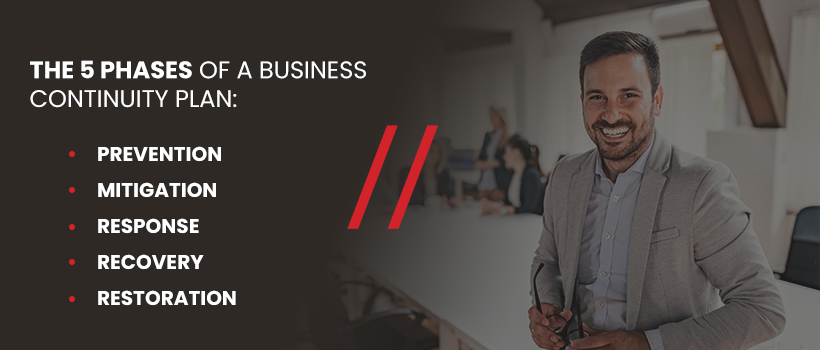
Before a disaster occurs, try to determine which disasters are the most likely to interrupt your business. For example, if your building sits beside a river, flooding could cause significant damage in the future. If your area is prone to frequent power outages, you could experience losses due to downtime.
You should also consider whether areas within your operation are prone to threats. In operations with heavy machinery working at high temperatures, keeping flammable objects away from the machinery at all times reduces the risk of fire. Make a list of the most likely threats specific to your business. These may include external environmental threats and internal threats.
In addition to cataloging your risks, note which functions are vital to your business operations. Some risks could cause damage, but still allow you to operate. Others may leave you completely unable to function.
After identifying potential threats and determining their impact on key business functions, the next step is to find ways to mitigate the damage caused by a disaster. The first method is to create contingencies ahead of disasters so that the business can continue functioning despite damage. For example, if your business depends on fuel and water supplies, establish a relationship with an emergency supplier to guarantee priority service, even during disruptions.
The second method is to prepare a guide for immediate action during a disaster. Though damage may still occur, well-trained employees will have a chance to rescue certain assets before they can be damaged. Practical training ensures employees know which actions to take and can complete them efficiently.
If a disaster happens, your BCP should help you assess the damage and determine the most practical actions to continue business. These instructions should be written as clear “if-then” statements. For example, “If the power in the facility goes out, then the employees should leave the building and work from home.”
Determine who will take the lead in executing these instructions. That way, those responsible can take action quickly, and all employees know whom to contact for support following an incident.
Depending on the disruption, you and your employees may be able to recover from damages on your own. For many disasters, it can be as simple as replacing damaged assets or restoring corrupted file data.
For more severe events like natural disasters, you’ll need to call a specialist to help recover from the damage. Take note of all damage, including that related to physical and digital operations. Prioritize restoring critical systems first. Emergency fuel or water delivery services can help your business return to operations as usual.
After recovery, the final step is to make sure everything is functioning correctly before returning to work. Test all critical systems, such as generators, HVAC systems and production lines, to ensure they operate safely before bringing employees back. After the incident, you should also review your BCP to determine what worked and what to improve should you face a similar situation in the future.
In addition to managing risks, the business continuity management process can benefit a business in a variety of ways:
When following the business continuity planning process, it helps to partner with an emergency specialist to ensure you have access to everything you need before a disaster strikes. Foster Fuels’ Mission Critical division is a national provider for emergency response services and the award-winning contact of choice for the Federal Emergency Management Agency (FEMA) and the Defense Logistics Agency (DLA). From emergency fuel and water delivery to emergency response training, our emergency services are unrivaled across the nation.
We value the opportunity to be your strategic partner for emergency services. Contact us today to see how we can fit into your business contingency plan.